Built to Last: Foundation 5 of 7
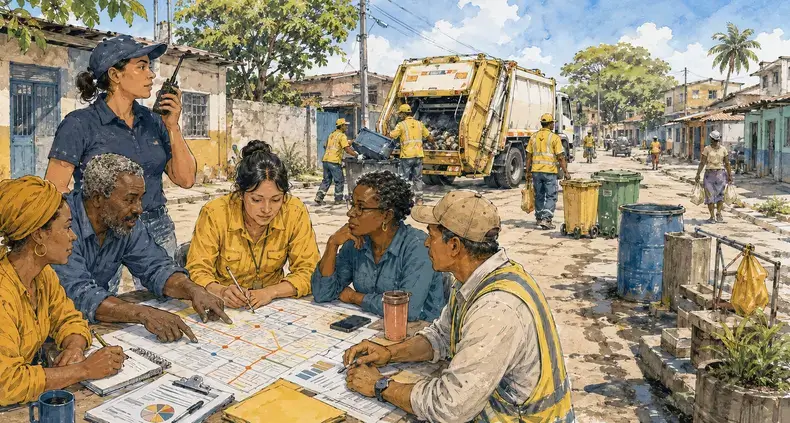
Many cities talk about bringing waste pickers into a formal system. Yet workers are already collecting, sorting, transporting and trading materials every day. Their routes, knowledge, relationships and organisations are part of the waste system, even when official plans ignore them.
In this Built to Last webinar, Federico Parra, WIEGO’s Waste Picker Programme Coordinator for Latin America, explains what genuine recognition means for workers and the wider waste system.
Drawing on Colombia’s experience, Federico explores how waste picker organisations secured legal recognition and payment as public recycling service providers. He also examines the continuing challenges of competition, regulation and formalisation without displacement.
Built to Last is produced by Global Waste Lab in partnership with be Waste Wise. It forms part of Global Waste Lab’s contribution as a Knowledge Partner to the ISWA World Congress 2026. The series has been endorsed by the Chartered Institution of Wastes Management (CIWM) as suitable for continuing professional development.
Watch the full webinar
Zoë Lenkiewicz and Federico Parra explore Colombia’s worker-led journey from exclusion to legal recognition and payment as public recycling service providers, and what other cities can learn from it.
Key takeaways
Start with the system that already exists
Before designing a new project or contract, identify the workers, organisations, routes, infrastructure and markets already moving materials. Ignoring them can destroy functioning services as well as the livelihoods and knowledge that support them.
Recognise rights, not only contributions
Praising waste pickers’ environmental contribution is not enough. Recognition should affect representation, secure access to recyclable materials and payment for the public service they provide, rather than only the value of the materials they sell.
Treat collective organisation as an asset
Cooperatives and associations allow workers to represent themselves, organise services and negotiate collectively. Worker-informed censuses and registries can make an overlooked workforce visible without allowing official definitions to exclude the people they should recognise.
Formalise without displacing
Formalisation should improve incomes, safety and social protection. Rules designed around large companies can instead create barriers or allow others to capture the value workers created. Change should strengthen existing systems without taking them away from the people who built them.
Short insights from the webinar
When formalisation becomes another barrier
Formalisation should bring recognition, remuneration, social protection and better working conditions. Federico explains why rules designed without workers can simply create another barrier, and why formalisation must be defined from a worker’s perspective.
The state is not neutral
When recycling markets fail, waste pickers bear the cost. Federico describes how Colombian waste pickers used a sea of plastic bottles to demand action, and explains why governments need to regulate imperfect markets.
Read the full transcript
Read the edited transcript of the conversation between Zoë Lenkiewicz and Federico Parra below.
Show full transcript
Full webinar transcript
This transcript has been edited for clarity and concision. Names and technical terms have been corrected, and webinar administration, poll mechanics, repetition and false starts have been removed. The substance of the conversation has not been changed.
Introduction
Zoë Lenkiewicz: Welcome to the fifth webinar in our seven-part Built to Last series, exploring what makes a waste system resilient.
Across our first four sessions, Mayor Talib Ahmed Bensouda in The Gambia showed how leadership and governance create the conditions for progress. Pushkar Pradhan in India showed how evidence supports better decisions. Lakshmi Menon, also in India, helped us look beyond technology to whether a solution fits the whole system around it. Anna de Chavez in the Philippines showed why people must be involved early enough for their knowledge to shape the design.
Today, we take the next step. What if the waste system does not begin with a new project? What if people, skills, relationships, routes and markets are already managing materials every day, but remain unrecognised when a new system is designed?
Built to Last explores Global Waste Lab’s Seven Foundations of a Resilient Waste System. The framework brings together lessons from the research behind UNEP’s flagship report, the Global Waste Management Outlook 2024, with more than 20 years of practical experience across waste policy, service design and delivery.
Today we are focusing on the fifth foundation, community asset recognition. I have grouped it into three practical ideas.
First, understand what already exists. People may already be collecting, sorting, repairing, trading and returning materials to use. They also hold valuable knowledge about routes, materials, buyers and community needs that might not appear in formal plans or datasets.
Second, move beyond acknowledging their contribution. Recognition affects people’s rights, representation, access to materials and whether they are paid for the service they provide, rather than only receiving the value of the materials they sell.
Third, improve safety, incomes and social protection without dismantling the relationships, livelihoods and knowledge that already make the system work. Recognising existing capacity does not mean romanticising hardship. It means building change with people rather than pushing them aside.
I am delighted to welcome Federico Parra, WIEGO’s Waste Picker Programme Coordinator for Latin America and a specialist in the social and solidarity economy. WIEGO is a global network that supports the movement of workers in informal employment, and Federico has worked alongside Colombia’s waste picker movement since 1997.
Colombia offers one of the most important examples of waste pickers organising for recognition as public recycling service providers. Federico has been closely involved in that journey and has documented how worker-led data can make an otherwise overlooked workforce visible.
From community assets to public service providers
Federico Parra: I have been working alongside the waste picker movement in Colombia since 1997. Today I would like to share not only a policy story, but a process that I have had the privilege of accompanying for almost 30 years.
I call this presentation From community assets to public service providers because the Colombian experience challenges a common assumption. When we talk about including workers in an informal economy in the waste management system, we often imagine that there is already a system and that workers need to be brought into it. But what if these workers are already part of the system?
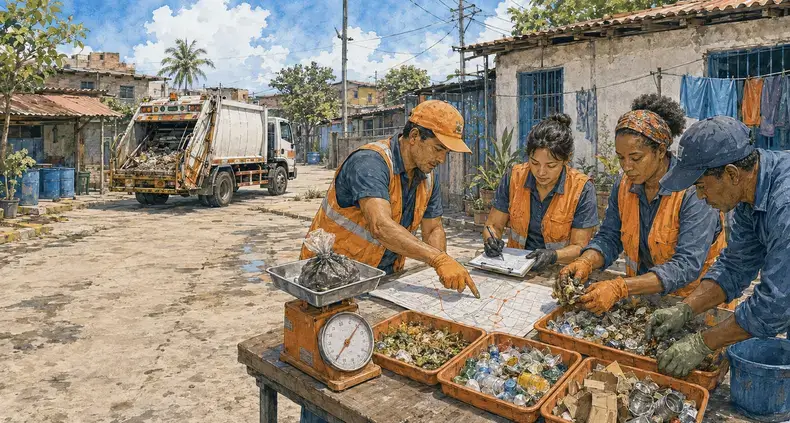
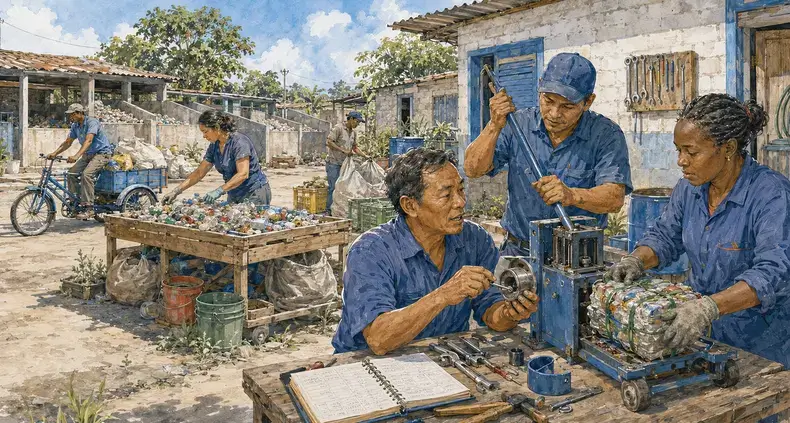
Waste pickers are not outside the waste system waiting to be included. They are already collecting, sorting, transporting and commercialising recyclable materials. Through decades of work – more than 80 years in our case – they have developed valuable knowledge, routes, relationships, organisations and infrastructure. They also sustain their families and an entire economy.
Waste pickers have historically connected households and other waste generators with warehouses, intermediaries and the recycling industry. They already occupy a functional place in the recycling value chain.
Their contribution goes beyond recovering materials. Their work reduces the amount of waste going to dumpsites or landfills, lowers costs for municipalities, provides raw materials to industry and generates environmental benefits.
For me, community asset recognition starts by changing the questions. Instead of asking how we can include waste pickers in a new system, we should first ask: what system already exists? Who makes it work? What do we risk destroying if we fail to recognise it?
The challenge is therefore not only inclusion. It is recognition and redistribution.
When modernisation displaces workers
Colombia also shows what happens when modernisation begins with the opposite assumption. For many years, modernisation of the waste management system meant privatisation, large contracts, new technologies and increasing restrictions on waste pickers’ access to recyclable materials. Dumpsites were closed without adequate livelihood alternatives. Waste pickers were pushed onto the streets and, at different times, their activities were restricted or criminalised.
We had a powerful paradox: the recycling system depended on waste pickers while public policy was trying to exclude them from that system. This is why access to recyclable materials became such a fundamental issue.
A banner used by waste pickers says, “Waste is to waste pickers what land is to farmers.” This is not simply a slogan. Recyclable material is a means of livelihood. If modernisation removes access to that material without providing an equivalent or better livelihood, it is not inclusion or formalisation. It is displacement.
This is precisely the warning behind Global Waste Lab’s principle of strengthening existing capacity without displacing the people whose livelihoods and knowledge already make the system work.
Organisation as a community asset
The Colombian story is not primarily about what government did for waste pickers. It is about what organised waste pickers achieved.
Organisations such as the Asociación de Recicladores de Bogotá, or ARB, and the Asociación Nacional de Recicladores built collective strength over decades. They combined organising, mobilisation, advocacy and strategic litigation with support from allies. I am proud to have been part of that process.
They did not simply demand access to social programmes. They demanded recognition as workers, economic actors and eventually public service providers. Through a series of Constitutional Court decisions, waste pickers progressively obtained legal recognition and special constitutional protection. The balance of power began to change.
Colombia therefore offers an important lesson for community asset recognition: community assets are not only individual skills or pieces of infrastructure. Collective organisation is itself an asset.
Waste pickers built cooperatives, associations and other social and solidarity economy organisations that enabled them to act collectively, defend rights, organise services, commercialise materials together and improve their economic position. The Constitutional Court explicitly recognised these organisations as legitimate forms of community participation in public service provision. They became both economic and political instruments.
Without organisations capable of representing workers, negotiating with governments and defending rights, recognition can remain symbolic. The Colombian experience was not simply government recognising waste pickers. Organised waste pickers claimed their rights and forced the system to recognise what was already there.
From vulnerability to rights
This transformation was about rights. Waste pickers moved from being treated mainly as a vulnerable population – and even described in terrible, dehumanising terms – to being recognised as rights holders and subjects of special constitutional protection.
If I see you only as vulnerable, I might offer assistance. If the state recognises you as a rights holder, it has obligations towards you. In Colombia, this translated into affirmative action and responsibilities for national and municipal authorities.
One of the most important rights is secure access to recyclable materials. You cannot recognise someone as a waste picker while allowing another actor to take away the material on which their livelihood depends.
Municipalities therefore have responsibilities not only to identify waste pickers through a census, but also to support their organisations, build their capacity, provide appropriate infrastructure and guarantee their participation in the waste management system. Recognition is no longer goodwill. It becomes an enforceable relationship between workers and the state.
Worker-led data and public service payment
Rights create a practical question: who are the workers who hold those rights? This might sound simple, but it is not. If government creates a definition in an office and then asks workers in an informal economy to fit into it, recognition can itself become a mechanism of exclusion.
In Bogotá, the process of identifying waste pickers became increasingly connected with waste picker organisations themselves. Workers know who works, where they work, how routes operate, how materials move, the prices paid and how the value chain is organised.
In practice, waste pickers and their organisations recover materials, transport them and sort them at recycling centres. Some of those centres belong to the organisations. Every tonne returned to the recycling value chain is weighed and registered.
Those tonnes are reported through the public service information system. They become part of the official measurement of the recycling service and are used to calculate the payment made by citizens for that service. Waste picker organisations need administrative systems to record the material recovered, collected, transported and commercialised, and to report the service through the official system.
Payment is then made to the waste picker organisation, which distributes it among its members according to the recyclable material each worker has recovered and delivered.
This is not only about making workers statistically visible. It transforms everyday work into a recognised, measured and remunerated public service.
Recognition becomes redistribution
Historically, waste pickers earned income from only one part of the value they created: the market price of the recyclable materials they sold. That commercial price does not pay for the work of collecting, transporting and sorting materials, diverting them from dumpsites and landfills, and reducing costs for municipalities.
The Constitutional Court expressed this clearly: if waste pickers did not perform these activities, somebody else would have to be paid to do them.
Court decisions and subsequent regulation opened the way for waste picker organisations to be recognised as providers of the public recycling service. They gained the right to receive payment for that service in addition to the income from selling recovered materials. We moved from material value alone to material value plus service remuneration.
This is where recognition becomes redistribution.
It changed more than workers’ incomes. It required municipalities, waste companies, service users and regulators to reorganise some of their relationships. The remuneration scheme remains imperfect. It does not fully reflect waste pickers’ real costs and has been subject to tensions and corruption. But it has generated income and improved material conditions for workers and their organisations. Recognition affects how value is distributed.
Workers became rights holders. Their organisations became public service providers. Collective commercialisation, shared infrastructure and working at a larger scale also strengthened their ability to negotiate and generate income. Research has found a relationship between the size of waste picker organisations and their members’ potential income.
Municipalities acquired responsibilities towards waste pickers. Data made an existing workforce institutionally visible, while payment began to redistribute part of the value created by workers’ labour. The Colombian case therefore helped to reconfigure the public waste management system itself.
There was even a change in the waste hierarchy, with recycling gaining priority over final disposal in a system that had historically prioritised collection, transportation and burial in dumpsites and landfills.
But this is not a perfect success story. The struggle continues. Waste picker organisations still face regulatory requirements designed with stronger formal actors in mind, insufficient municipal support and unfair competition from private companies seeking to capture the remuneration that waste pickers fought to establish.
Formalisation can recognise workers, but badly designed formalisation can also displace and exclude them.
Four lessons from Colombia
First, start with what already exists. Before designing a new system, map the workers, organisations, routes, knowledge, infrastructure and economic relationships that already keep materials moving.
Second, recognise rights, not only contributions. It is easy to praise waste pickers for their environmental contribution. Recognition must also affect representation, access to materials and economic rights.
Third, strengthen collective organisation and the social and solidarity economy. Cooperatives, associations and other worker organisations allow waste pickers to represent themselves, defend rights, organise services, commercialise collectively and reach scale. This is almost impossible for individuals acting alone.
Fourth, redistribute value. If workers already provide an essential environmental and public service, recognition should improve their livelihoods and working conditions.
The Colombian journey can be summarised as rights, recognition, remuneration and system transformation.
Do not start by asking how workers in an informal economy can fit into the waste system you want to build or improve. Start by asking what system they have already built, and how you can make it safer, fairer and stronger without taking it away from them.
Discussion
Why must workers help design a census and registry?
Zoë: Colombia’s census and registry were developed with waste picker organisations. What did that make possible, and what can go wrong when authorities define and count workers without them?
Federico: The Constitutional Court made the census mandatory. That is important because we need political will and an economic and political decision to count workers.
Earlier census processes failed because people were asked to come forward and identify themselves as waste pickers. The improved methodology went into the streets with waste picker organisations, because those organisations know the routes, workplaces, materials, intermediaries and value chains.
The questions, language and definitions also need careful design. There can be a thin line between waste pickers and intermediary actors, and workers might move between roles. Migration status, family circumstances and the division of labour within households also need to be understood. Behind each worker is often a family operating as a productive unit.
It is not enough to conduct a census once. In Bogotá, the information is updated regularly through a unified registry of organisations and workers. This allows authorities to make strategic decisions, recognise organisations and develop programmes that strengthen economic capacity, administration and infrastructure.
The value-chain knowledge held by workers and the political decisions made by government must come together. Over the medium and long term, that enables real integration and recognition.
Who pays for the recycling service?
Zoë: How does the payment system work, and are waste picker organisations subject to the same taxes and regulatory requirements as private companies?
Federico: A waste picker who belongs to an organisation collects recyclable material before the conventional collection system takes residual waste to landfill. The material arrives at the organisation and is measured in tonnes. This information is reported to government.
Households pay for the waste management service. Part of that payment covers the residual waste collected by conventional companies, and part pays waste picker organisations for the recycling service they provide.
This is not their only source of income. They also sell materials and are seeking stronger payments through extended producer responsibility. The packaging industry benefits because waste pickers reduce environmental impacts and provide a substantial share of the raw material used to manufacture new packaging.
Waste picker organisations do pay taxes and must be registered. They are also monitored by the public service regulator. However, putting recycling into open competition created serious problems, because the system allowed companies with far greater financial power to compete for the remuneration waste pickers had fought to establish.
A later reform created a special regime giving waste picker organisations exclusive rights to provide the recycling service for a 15-year period. Implementation is ongoing, and competition from larger companies remains a challenge. Colombia’s model is still evolving.
How can workers gain confidence in formal systems?
Zoë: Waste pickers can be reluctant to work with formal organisations. What helps build confidence?
Federico: Nothing works better than learning from another worker’s experience. The process starts small. When one organisation, then two or three organisations, develop their systems and begin working with collection companies, citizens and authorities, others see that progress is possible.
Clear rules and short-term benefits are important. Workers live with immediate daily pressures. Money saved within a cooperative is money that is not available to buy food for a family that day. We therefore tried to produce concrete benefits in the short term while allowing organisations to grow gradually.
The system needs continual adjustment, conflict resolution and reliance on waste picker leaders who understand the context and culture. Training should build a collective identity and help workers understand that recognition is not a favour from the authorities. It is something they have fought for and won.
When formalisation becomes another barrier
Zoë: Some workers do not want to be formalised or registered because they fear oversight. How do you respond to those concerns?
Federico: Formalisation is contested. For many people, it simply means registering and paying taxes.
In Colombia, we talked about recognition and remuneration linked to decent work: collective voice, access to social protection, better income, shorter working hours and occupational safety. It is a rights-based approach to formalisation.
If formalisation in your context is a top-down definition that requires individuals or productive units to compete in a market and comply with labour rules that were not designed for workers in an informal economy, it is simply another barrier.
Formalisation gained meaning over time in Colombia. At the beginning, we did not talk about formalisation. We talked about recognition, integration, extending social protection and other concrete aspects of decent work. These allowed formalisation to be defined from a worker’s perspective.
What if workers handle only a small share of the waste?
Zoë: In some smaller towns, workers in an informal economy handle only a small proportion of waste and very little organic material. What is the best strategy when both state and informal provision are limited?
Federico: The first question is: which materials have a market in your country? In Colombia, cardboard, glass, metals, plastics and sometimes wood have established value chains. The proportion also varies with household income and the amount of packaging consumed.
Organic waste, hazardous waste and construction waste have not been developed in the same way. We might be talking about 12 to 18 per cent recyclable material, depending on the context.
Waste pickers also do the sorting that households do not. They know the materials but often receive them mixed together, even after years of public education. Making the work safer and more efficient therefore requires source separation by households, supported by education, monitoring and enforcement.
Payment for the recycling service creates an incentive and can increase recycling. But it also creates opportunities for fraud if other actors begin claiming tonnages that are not real. The regulator needs strong and complementary monitoring systems.
Can deposit return and EPR systems reduce workers’ access to materials?
Zoë: Could deposit return schemes cause conflict if householders begin returning valuable containers themselves, reducing waste pickers’ access to those materials?
Federico: This is part of the wider extended producer responsibility challenge. Environmental programmes can affect waste pickers’ incomes even when they are well designed for other purposes.
Households need to understand the contribution of waste pickers and, where possible, maintain a preferential relationship with them. Waste pickers have helped decarbonise the economy, extended the life of final disposal facilities and supported their families through this work.
We cannot oppose EPR systems in principle. The stronger examples connect EPR directly with waste picker organisations instead of bypassing them through packaging companies or parallel value chains. The collection interface should be linked to worker organisations.
How do public and private services coexist?
Zoë: Does the waste picker model create conflict with private companies contracted by municipalities? Are waste picker organisations also collecting residual waste?
Federico: The two service lines are separate. Waste pickers collect recyclable materials. Conventional collection companies collect residual waste, although it still contains recyclables, so waste pickers need to recover those materials first.
The basic public service payment for a tonne of recycling is linked to the payment for collecting, transporting and disposing of a tonne of residual waste. Recyclable tonnages are much lower, but conventional companies strongly resisted the recycling system at the beginning. The conflict was intense. Eventually, both service providers received differentiated payments.
The payment to waste pickers recognises a service they were providing long before the current collection system existed. Market prices for individual materials still change considerably.
When plastic prices collapsed, Colombian waste pickers created a sea of plastic bottles in a major public square as a demonstration. Their message was that the state is not neutral or absent. It has a responsibility to regulate imperfect recycling markets. This forms part of the case for a special regime for waste pickers.
What is the role of private companies?
Zoë: How can private waste management or technology companies engage waste pickers without creating labour-law liabilities when the workers are not their employees?
Federico: The responsibility cannot sit only with a private company. The state also has a role, alongside worker organisations and the rest of the value chain.
Social and solidarity economy organisations can support decent work, but they need viable collective business plans. We need to understand how much value is produced and the different sources of income available through service charges, material markets, producer responsibility and the environmental value of decarbonisation. The money exists, but it needs to be redistributed.
In Colombia, government has begun extending occupational risk protection through cooperatives and associations. The state contributes funding, while organisations and workers also contribute, helping to expand social protection.
The solution therefore combines cooperatives and associations, public policy, state responsibility and value-chain responsibility.
How can stigma and discrimination be addressed?
Zoë: Waste pickers are often stigmatised and chased away from neighbourhoods. Some have limited literacy or are reluctant to attend formal training. Where can advocates begin?
Federico: We began from exactly that position in 1997. Popular education starts by understanding workers’ own view of the world and what it means to experience discrimination. It also supports workers in collectively redefining how they see themselves.
This is a medium- and long-term process. The International Alliance of Waste Pickers, the Latin American and Caribbean Waste Pickers Network and Colombia’s National Association of Waste Pickers have all played important roles. Workers organise themselves, and nothing works better than one worker showing another worker a successful example.
Rely on the organisations that already exist. The achievements belong to the workers. Technicians, NGOs and other partners contribute to the process.
Closing reflections
Zoë: Recognition must mean more than praising people’s contribution or inviting them into a finished plan. It needs to influence rights, representation, access to materials and how the value of the service is shared.
The waste system already exists before a project arrives. Improving working conditions must not become an excuse to push out the people whose knowledge and labour already hold that system together. The task is to recognise what exists, address what is unsafe or unfair, and build something stronger together.
Our next session will explore climate integration with Dr Andriannah Mbandi. Waste management is a local service with major consequences for climate and public health. We will look at methane from organic waste, black carbon and toxic pollution from open burning, and how stronger waste systems can support climate policy and finance.